

Hashing state machines
For hashing, the zkEVM utilizes two state machines: the Keccak state machine and the Poseidon state machine. The Keccak-256 hash function is used for seamless E
For hashing, the zkEVM utilizes two state machines: the Keccak state machine and the Poseidon state machine. The Keccak-256 hash function is used for seamless EVM compatibility, whereas Poseidon is best suited for the zkProver context because it is a STARK-friendly hash (SFH) function.
The sponge construction
By design, Keccak and Poseidon are both sponge constructions. A generic sponge construction is a simple iterated construction for building a function:
with an input of variable-length and arbitrary output length based on a fixed-length permutation:
operating on a fixed number of bits.
The array of bits that keeps transforming is called the state, and is called the width of the state.
The state array is split into two chunks, one with bits and the other with bits. The width , where is called the bitrate (or simply rate) and is called the capacity.
Sponge construction phases
The elements that completely describe a single instance of a sponge construction are: the fixed-length permutation , the padding rule pad, the bitrate value , and the capacity .
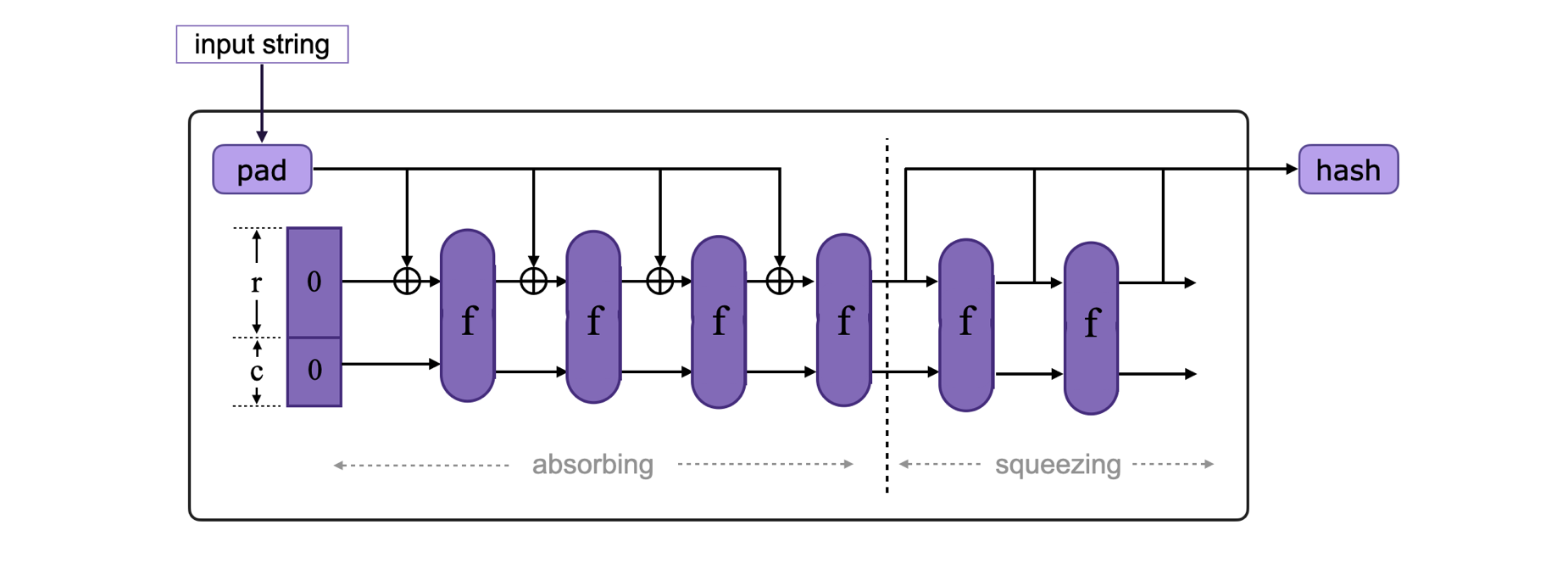
A schema of the sponge construction is shown in the below figure.
Initializing phase
The input string is either padded to reach the -bit length (if it was shorter than bits) or split into -bit long chunks, with the last one padded to reach the -bit length (if it was longer than bits). A hash function-specific reversible padding rule is used.
The state of the hash function is initialized to a -bit vector (or array) of zeros.
Absorbing phase
During this phase, the -bit input blocks are XOR-ed sequentially with the first bits of the state, intermixed with permutation function applications. This process is repeated until all input blocks have been XOR-ed with the state.
Take note that the last bits, which correspond to the capacity value, do not absorb any external input.
Squeezing phase
The first bits of the state are returned as output blocks in this phase, intermixed with applications of the function . The number of output blocks is entirely up to the user.
Keep in mind that the last bits, which correspond to the capacity value, are never output during this phase. Actually, if the output is longer than the specified length, it is truncated to the required size.
Last updated on
Memory-align state machine
The Memory-align state machine is a secondary state machine that includes an executor (the Memory-align SM executor) and an internal Memory-align PIL (program)
Keccak framework
The zkEVM, as an L2 zk-Rollup for Ethereum, employs the Keccak hash function to achieve seamless compatibility with the Ethereum blockchain at Layer 1. However,